How Parents Can Assess a Hospitality Institute Before Admission
The selection of a hospitality institute is a serious decision for the students and parents. Students should have an interest in hotels, food, travel, service, or tourism. As a parent, you want to make sure that the course is well organised, practical, career-oriented, and worth the money you spend.
The direct answer is this: parents should evaluate a hospitality institute by checking its course structure, practical training, faculty support, industry exposure, campus facilities, internship guidance, career pathways, and student environment. A good institute should make students realise the hospitality industry in a realistic way and should not force the course.
If your child is considering hospitality, culinary, or tourism education after 12th, VMSIIHE in Goa can help parents and students understand the programs offered, the practical learning environment, and career direction. Talk to VMSIIHE and find the right path before making a decision on admission.

Why parents should look past the course name
Many parents begin with the question, “Is hotel management a good career?” That’s a good question, but it should be followed by a second question, “What kind of training will my child be getting?”
Hospitality education happens outside the classroom, too. It includes hotel operations, food and beverage service, culinary training, guest communication, housekeeping standards, tourism awareness, teamwork, and professional behaviour. The quality of learning depends on how an institute relates theory to practical exposure.
Don’t choose the institute just because it sounds like a popular course. The real value of the institute is in how well it prepares students for the world of work.
1. Check whether the course matches the student’s interests
Hospitality is a broad field. Some students are interested in hotel operations. Some prefer culinary arts. Some enjoy travel and tourism. Others are drawn to guest service, events, food and beverage, or management.
Before admission, parents should help students identify what excites them. A student who enjoys cooking may need a culinary arts pathway. A student who enjoys guest interaction may be suited for hospitality management. A student interested in tourism may look for hospitality and tourism-focused learning.
The right institute should be able to explain the differences clearly instead of pushing every student in the same direction.
2. Evaluate practical training facilities
Hospitality is a tactile business. You can’t learn hotel service, kitchen work, guest handling, or operations from textbooks alone.
Parents need to check if the institute has practical training spaces like kitchens, service areas, housekeeping labs, front office learning spaces and other hospitality training facilities. These spaces expose students to real industry standards.
Practical training also builds confidence. Students learn to work as teams, abide by grooming standards, handle pressure, keep clean and communicate professionally.
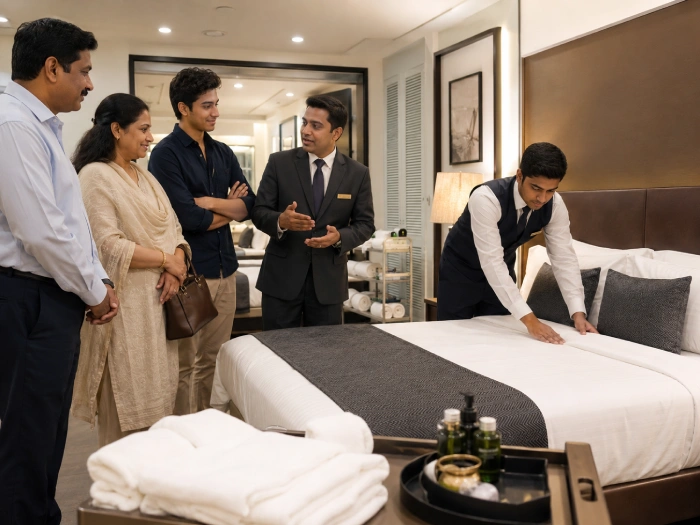
3. Understand the industry exposure offered
Industry exposure is key because hospitality is a people-facing, service-driven industry. It’s helpful for students to understand how hotels, resorts, restaurants and tourism businesses operate in the real world.”
Ask about internships, exposure to hotels, guest lectures, workshops, industry visits or professional interaction. Such experiences help connect classroom learning with real hospitality careers.
But parents also need to watch out for exaggerated claims. No institute should be judged on promises alone. Focus on structured exposure, skill development and realistic career preparation.
4. Review faculty and student support
Faculty support matters a lot in hospitality education. Students after 12th are still developing confidence, discipline, and professional habits. They need guidance, correction, and encouragement.
Parents should check whether the institute has experienced faculty, approachable mentors, and student support systems. A good hospitality institute should help students improve communication, grooming, teamwork, discipline, and problem-solving.
Parents should also observe whether the institute treats students professionally. Hospitality requires respect, punctuality, presentation, and service attitude. These values should be visible in the learning environment.
5. Look at career pathways, not just placements
Placements are often the first question that parents ask. Not the only consideration, but placement support is key. The more useful question is, “What career doors does this course open?”
Over time, hospitality graduates can develop careers in hotels, resorts, restaurants, cruise operations, tourism, events, food production, guest relations, sales, reservations, and management. Culinary students may work in professional kitchens, bakeries, food entrepreneurship, catering, or related food businesses.
Your career growth in hospitality is dependent on skill, attitude, experience, communication, and consistency. Look for an institute that helps students build these foundations.
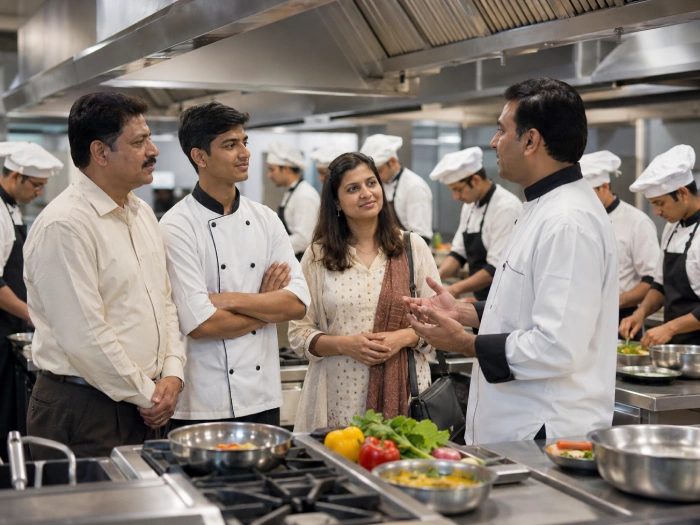
6. To check if the institute promotes professional behaviour
In hospitality, attitude is everything. A student has to learn how to speak, dress, respond, listen, solve problems, and work with different backgrounds.
Parents should check if the institute encourages discipline, grooming, communication, and professionalism. These are not minor details. Where they really matter is in student performance in internships, interviews, and early career roles.
At VMSIIHE, hospitality education is built on practical learning, professional development, and industry relevance so that students are able to understand hospitality as a real working profession.
7. Compare course options carefully
Parents should be aware of the difference between hospitality management, culinary arts, postgraduate hospitality education and short-term courses before making a decision.
A full-time degree may suit students looking for a structured long-term career pathway. A culinary arts programme may suit students serious about food production and kitchen careers. A postgraduate programme may suit graduates who want advanced hospitality and tourism management knowledge. Short-term courses may support specific skills, depending on the student’s goal.
The best choice depends on age, interest, academic stage and career direction.
8. Visit or enquire before deciding
A website can provide information, but a direct query can clarify. Parents should communicate with the institute, ask questions, and understand the student experience.
Examples of useful questions are the following:
What practical training is available?
Which departments will students know of?
What kind of industry exposure is provided?
How do you counsel the students for internships or for jobs?
And what about the students who still don’t know what they want to do? Such questions help parents to make more confident decisions.
These questions help parents make a more confident decision.
Final thoughts
Parents should be looking for a hospitality institute that has both trust and practicality. The right institute should give a course, but also build confidence, skills, discipline, and career clarity in a student.
For students who enjoy service, food, travel, teamwork, and professional engagement, hospitality can be a rewarding career. But the basis is important. The way students begin their journey can really make a difference if they’re part of a well-structured institute with practical training, industry exposure, and guidance.
If you are a student or parent looking for hospitality education in Goa, VMSIIHE provides hospitality, culinary, and tourism education pathways that support practical learning and career-focused development. Talk to VMSIIHE to know the right program for your child’s interests and future ambitions.
FAQs
Parents should check the course structure, practical training, industry exposure, faculty support, campus facilities, student guidance and career pathways before choosing a hospitality institute.
Yes. Practical training is essential because hospitality careers require service skills, kitchen skills, communication, teamwork, grooming, hygiene awareness and real-world confidence.
No. Placements are important, but parents should also evaluate skill development, internships, professional training, student support and long-term career pathways.
Parents should look at the student’s interests, personality, communication skills, willingness to work with people, interest in food or travel, and comfort with practical learning.
Goa has a strong hospitality, tourism and resort environment, which can help students understand the industry more closely. Parents should still evaluate the institute’s course quality, training and support before deciding.