
Food Cost Control and Menu Engineering Guide for 2026 | VMSIIHE
The Guide on Food Cost Control and Menu Engineering for 2026. Food service businesses in 2026 are operating in an environment shaped by tighter margins, shifting guest expectations, rising ingredient prices and intensifying competition. According to supposed culinary experts, it is no longer sufficient for a hotel, restaurant, café or institutional kitchen to serve great food. A business’s profits depend as much on its cost controls as on its menu design and profitability drivers.
Food cost control and menu engineering are thus essential facets of hospitality management. These concepts allow organizations to provide value sustainably while being profitable. It is important for students and professionals in the hospitality field to develop these skill sets for their success.
How to Control the Cost of Food?
Comprehending Food Cost Ratio.
Food cost control means managing the cost of ingredients, inventory, purchasing, and waste to make business profitable. One of the key metrics that is used is the food cost percentage. This metric helps in comparing the cost of food to food revenue.
The profit margins can be heavily impacted, despite strong sales, due to a high food cost percentage. Hence, maintaining optimum cost and pricing is very crucial.
The Importance of Regulating Food Costs.
Control costs of food
Enhance Profitability
Minimize rubbish
Ensure food quality remains constant
Aid decisions for better pricing
Importance of Food Cost Control
- Controlling your food costs is essential.
- Enhance earnings ratios.
- Minimize trash.
- Quality in food should remain consistent.
- Assist in making pricing choices better.
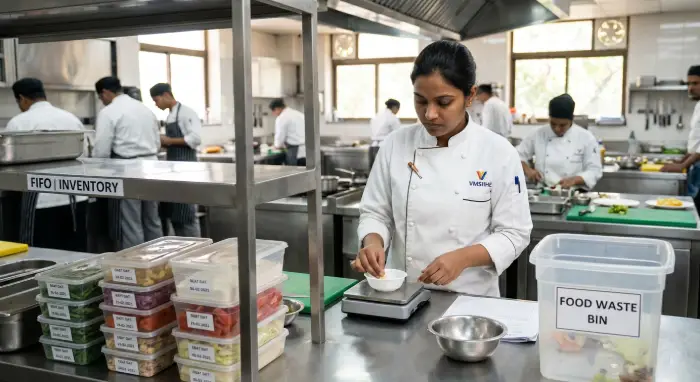
Key Components of Food Cost Control
Procurement and Supplier Management.
When purchasing smartly, businesses ensure the correct price and quantity of the ingredients. Regular evaluations of suppliers, price negotiation and demand forecasting help to eliminate wasteful expenditure and spoilage.
Controlling stock and inventory.
Effective inventory management systems assist businesses in keeping track of stock levels, minimising losses and ultimately, increasing profit. The FIFO (First In, First Out) technique is employed to utilize older stocks before using the newly purchased ones.
Control servings and standard recipes.
Cost and quality are consistent with standard recipes and portion sizes. If you don’t have them, the prices you pay for food can vary, messing with your pricing and profit management.
Garbage disposal.
Waste food cuts into profit. Three key techniques for control waste are reducing spoilage, avoiding overproduction and optimising preparation.
Measuring and Cost Evaluation.
Frequent audits and checking stock levels and costs reveal inefficiencies Cost control measures must be monitored constantly.
What Is Menu Engineering?
Menu engineering refers to analyzing the profitability and popularity of menu items and their combinations. It allows businesses to find out which items are generating the most revenue and which ones are failing.
Function in Hospitality Management.
Support for menu engineering.
Established Pricing Policies.
Improved design and layout of the menu
Established Pricing Policies.
Established Pricing Policies.
Established Pricing Policies.
Improved design and layout of the menu
Elevated customer experience.
Profitability was enhanced.
Understanding the Menu Engineering Matrix
The Four Menu Categories
Menu engineering divides items into four categories:
- Stars: High profitability and high popularity
- Puzzles: High profitability but low popularity
- Plow Horses: Low profitability but high popularity
- Dogs: Low profitability and low popularity
Strategic Actions for Each Category
- Promote and highlight Stars
- Improve visibility or appeal of Puzzles
- Adjust pricing or portions for Plow Horses
- This matrix helps businesses make informed decisions about menu design and performance.
How Food Cost Control and Menu Engineering Work Together

Comprehending Food Cost Ratio.
A Combined Approach to Profitability Food cost control manages expenses, while menu engineering aims to boost revenue. Used together, they create a balanced path to better profits.
Example in Practice A popular dish with high food cost might need portion tweaks or a price adjustment. Likewise, a high-margin dish that doesn’t sell well may need stronger promotion or a better spot on the menu.
This integration makes sure operations stay efficient while keeping customers satisfied.
The profit margins can be heavily impacted, despite strong sales, due to a high food cost percentage. Hence, maintaining optimum cost and pricing is very crucial.
Food Cost and Menu Trends in 2026
Data-Driven Decision Making
Restaurants are increasingly using digital tools and POS systems to track menu performance and food costs in real time.
Sustainability and Local Sourcing
Consumers are more conscious of sustainability. Businesses are focusing on local sourcing and reducing waste.
Streamlined Menus
Smaller, more focused menus are becoming popular as they improve efficiency and reduce operational complexity.
Dynamic Pricing Strategies
Pricing strategies are becoming more flexible, allowing businesses to adjust prices based on demand, seasonality, and cost fluctuations.
Practical Tips for Hospitality Students and Professionals
Develop Good Price consciousness.
Know the prices of all ingredients and their effect on the price of the final dish.
Use Standard Recipes
Use standardized recipes to ensure consistency and control costs.
Analyze Menu Performance
Periodically assess what sells and what is popular to make menu choices.
Minimize Waste
Arrange in advance what you need to prepare and minimize waste in the kitchen.
Become Data and Technology Embracive.
Informed pricing and menu planning decisions are made using data-driven insights.
Conclusion
In 2026, food cost control and menu engineering are the keys to success in a hospitality industry. Food cost control provides an efficient operation and less waste whereas menu engineering is used to maximize profitability by designing smart menu.
They combine to offer a strategic management of food and beverage operation. To students and professionals, it is essential to have mastered these concepts in order to remain competitive in a changing industry.
FAQs
1. What is food cost control in the hospitality industry?
The control of food costs refers to the procedures of controlling the purchasing, stocking, and portion sizes and waste in order to make food businesses profitable.
2. What is menu engineering?
Menu engineering is a method of analysing menu items in relation to profitability and popularity to enhance the menu performance and revenue.
3. Why is portion control important?
Portion control also guarantees uniformity in the quality of food and allows one to control the predictability of food costs.
4. What are the four categories in menu engineering?
These are the four types: Stars, Puzzles, Plow Horses, and Dogs.
5. What are the significance of these concepts in 2026?
They are essential because of the increase in costs, evolving customer demands and because of the necessity of making decisions in the hospitality sector that are data-driven.