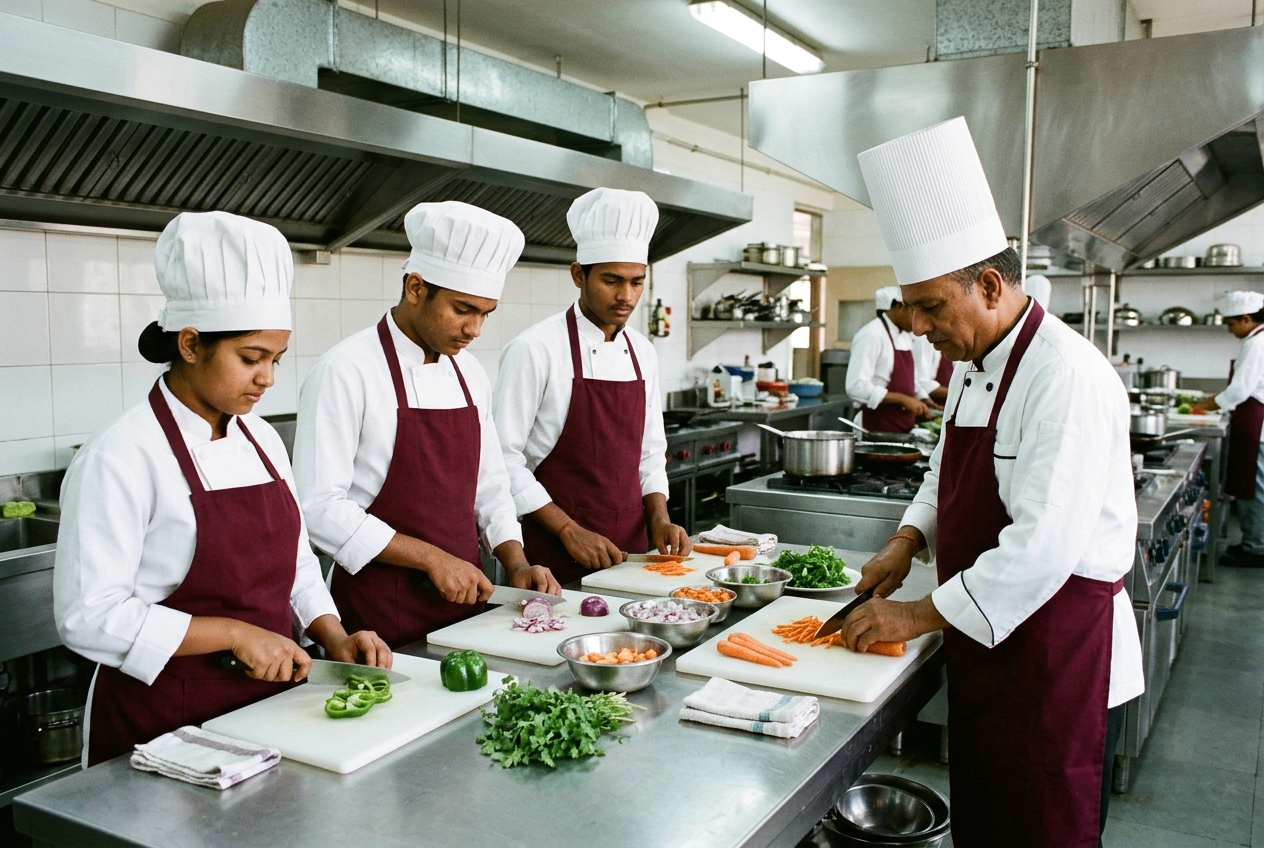
What is the Certificate Course in Culinary Arts at VMSIIHE?
VMSIIHE lists two certificate programmes, each of 9 months: the Certificate Course in Culinary Arts and the Certificate Course in Bakery and Patisserie. The culinary certificate is a short-term chef course for learners who want to build real kitchen skills without committing to a long programme. VMSIIHE, Goa is “An Autonomous Institute Affiliated to Goa University” and is “Accredited by NAAC with A Grade”.
What you learn in 9 months
The short term courses page says the course introduces learners to:
• Essential food production methods
• Culinary tools and equipment
• Personal hygiene
• Kitchen planning
• Team collaboration in a commercial kitchen environment
The page also has a section on competencies and outcomes. For the current syllabus, module list and learning outcomes, check that page or ask Admissions.
Courses of this kind generally build a base in areas such as knife handling, basic cooking methods, stocks, soups and sauces, Indian and continental dishes, kitchen safety and working to a service routine. Treat this as a general guide and rely on the page for what VMSIIHE currently teaches.
Where you practise
Culinary skills grow in real kitchen conditions, so ask about the training spaces. VMSIIHE lists an in-house training kitchen, a training bakery, a live demo kitchen with a big screen, a training bar and restaurant, and a mock guest suite and housekeeping lab. Ask Admissions which spaces the certificate batch uses. The short term courses page also mentions internship opportunities, so ask Admissions how these work for the certificate.
Who the certificate course suits
• Students who want a faster, practical route into kitchens. Nine months is a short programme, focused on learning to work in a commercial kitchen.
• Career changers. If you are moving from another field into food production, a focused course lets you start learning kitchen basics without a long programme.
• Students unsure about a 3-year degree. A shorter course gives you a clear look at kitchen work before you make a bigger decision.
If your interest is baking and pastry rather than the main kitchen, VMSIIHE’s other certificate is the Certificate Course in Bakery and Patisserie, also 9 months. Our guide on how to become a pastry chef in India explains the routes into that career.
Certificate or B.Sc. Culinary Arts: which fits you?
Both are offered at VMSIIHE, and they serve different needs.
Certificate Course in Culinary Arts
Duration: 9 months
Entry: Check eligibility on the short term courses page
Focus: Essential food production methods, tools and equipment, hygiene, kitchen planning and teamwork in a commercial kitchen
Suits: A faster, practical start, career changers and students still deciding
More details: Short term courses
B.Sc. Culinary Arts
Duration: 3 years
Entry: 10+2 or equivalent from Arts, Commerce, Science or Vocational streams, from a recognised board in India or abroad
Focus: Knife skills, bakery and patisserie, HACCP food safety, French, Indian regional, Pan Asian and European cuisines, menu engineering, food styling and photography, kitchen cost control
Suits: Students who want depth, a wider range of cuisines and the management side of kitchens over three years
More details: B.Sc. Culinary Arts
Neither route is better for everyone. Ask yourself:
• Am I sure I want a kitchen career, or do I want to find out first?
• Do I want a shorter, focused programme or a broader degree?
• Do I want to study menu engineering, kitchen costing and several cuisines in depth?
• Can I commit to three years right now?
Questions to ask before you enrol
• What is the current syllabus, and what outcomes does the course list?
• What are the eligibility and admission criteria?
• How are practical sessions organised?
• How do internship opportunities work for the certificate?
• What are the batch start dates and fee details, and what does the fee include? Ask for these in writing.
Our recommendation
If you want a faster, practical start or you are not ready for a 3-year commitment, the 9-month certificate is a sensible first step. If you already know you want a broad culinary education, the B.Sc. Culinary Arts offers more depth. Whichever you choose, read the current syllabus, visit the training kitchens and ask questions until the course feels clear.
 V. M. SALGAOCAR INSTITUTE
of International Hospitality Education
[An Autonomous Institute Affiliated to Goa University]